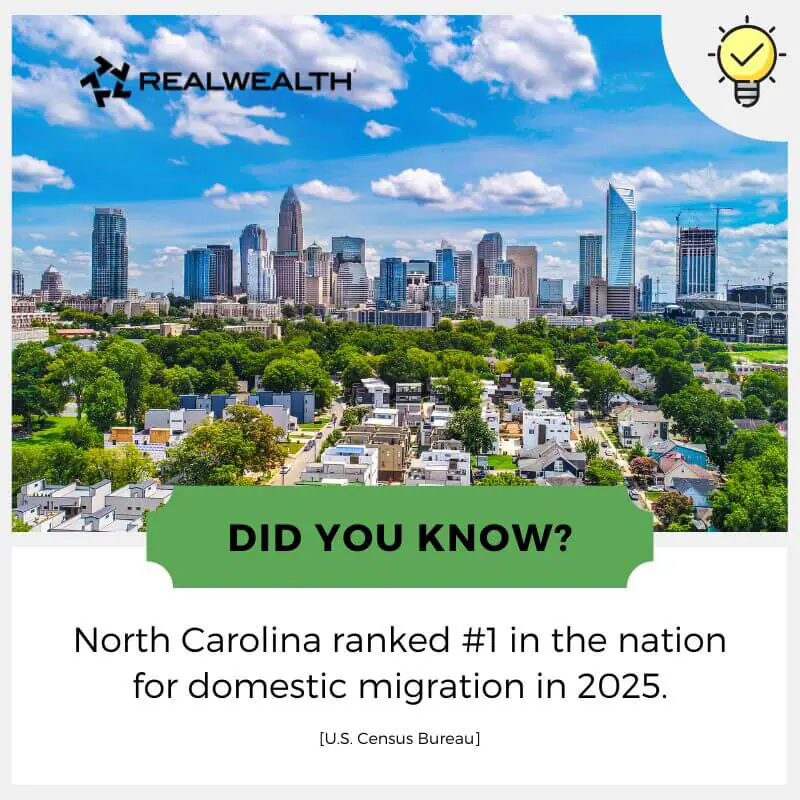
North Carolina keeps showing up on every list that matters for real estate investors. Before we get into North Carolina housing market predictions for 2026 and 2027, here’s the big picture: third in the nation for total population growth, adding nearly 150,000 new residents in 2025 according to the U.S. Census Bureau, number one for domestic migration, a tech and life sciences economy pulling talent from coastal markets, and home prices still well below comparable Northeast and West Coast markets.
Below, we delve into the North Carolina housing market, covering the statewide trends and predictions, and a deeper dive into Charlotte and Raleigh, two of the most-watched markets in the Southeast.
We draw on data from Redfin, Zillow, NC Realtors, the U.S. Census Bureau, and the Bureau of Labor Statistics. These are informed forecasts, not guarantees. Local conditions vary significantly across North Carolina metros.
Quick Answer: What are the North Carolina housing market predictions for 2026 and 2027?
North Carolina’s housing market is normalizing after years of rapid appreciation, and for real estate investors, that’s actually good timing. Here’s what the data shows heading into 2026:
- The population is still growing fast. North Carolina added nearly 150,000 people in 2025, ranking third nationally behind only Texas and Florida, according to the U.S. Census Bureau. The state ranked #1 for domestic migration; more people moved here from other states than anywhere else in the country.
- Home prices are stabilizing. Redfin puts the statewide median at $378,000 in February 2026, up 2.5% year-over-year. Zillow puts the average home value at $337,813, essentially flat. The market is finding its footing after the pandemic-era run-up.
- Inventory is improving. North Carolina entered 2026 with about 57,000 homes listed, up 9.3% year-over-year per Redfin. Months of supply sit at 5 months — approaching balanced territory. Buyers have more options and more room to negotiate than they’ve had in years.
- Charlotte and Raleigh are leading in appreciation. Zillow projects Charlotte prices to rise 2.8% and Raleigh 1.4% through 2026 as both markets absorb recent inventory gains and resume steady growth.
- Rental demand is holding up. Mortgage interest rates are keeping more households renting longer, supporting landlord returns across both metros.
Read on for the full breakdown of the state, including Charlotte and Raleigh.
Interested in markets like Charlotte or Raleigh? Join RealWealth for free to connect with our investment counselors and explore what’s available in similar high-growth markets
North Carolina Housing Market Predictions, Trends & Factors Influencing Growth
Before we break down what’s happening in Charlotte and Raleigh, here’s what’s happening statewide in North Carolina’s housing market.
1. Population growth and migration patterns
North Carolina is growing in ways that matter for housing demand. In 2025, more people relocated here from other states than anywhere else in the country, earning the state the #1 ranking for domestic migration. As of July 2025, the total population reached 11.2 million, up 1.3% year-over-year.
Most newcomers arrive from neighboring states like Florida, Virginia, South Carolina, and New York. They are chasing more affordability, a lower cost of living, better weather, and a job market that has consistently outperformed the national average. That inbound flow from larger, more expensive states creates a tenant base that’s often well-employed, financially stable, and looking to rent before they buy.
Most of that growth is landing in two places: the Charlotte metro and the Triangle (Raleigh-Durham-Chapel Hill). Mecklenburg and Wake Counties have both crossed the one-million-population mark. The suburbs surrounding both metros, places like Apex, Holly Springs, Fuquay-Varina, and Huntersville, are among the fastest-growing communities in the Southeast. That’s where housing demand is most concentrated as we head into 2026.
2. Economic & Job Growth
North Carolina’s economy closed out 2025 with its fifth consecutive year of growth since COVID-19, according to the UNC Charlotte Belk College of Business forecast. Real GDP grew 2.6% in 2025 and is projected to grow 3.0% in 2026. The state added 72,300 net jobs in 2025, and is forecast to add 80,800 more in 2026, with all 14 nonagricultural sectors expected to grow.
The 2025 job announcement numbers were record-setting. North Carolina announced 33,745 new jobs and $23.1 billion in investment commitments, according to WUNC, the most in state history. Major wins included:
- Novartis is investing $771 million in Durham
- Jabil is committing $500 million for AI infrastructure in Rowan County over several years
- JetZero announced a $4.7 billion airplane manufacturing facility in Guilford County, expected to create 14,500 jobs.
- CNBC named North Carolina its top state for business in 2025, the third time in four years.
The leading growth sectors are education, health services, professional and business services, and information technology. In Q2 2025, the average hourly wage statewide was $33.67, up 4.2% year-over-year, according to DMJPS, citing BLS data. Raleigh ($36.63) and Charlotte ($36.40) are the only metros exceeding both the state and national wage averages.

Source: DMJPS/US Bureau of Labor Statistics
3. Home Prices
The housing market in North Carolina is stabilizing after years of rapid appreciation. Redfin puts the statewide median at $378,000 in February 2026, up 2.4% year-over-year. Zillow puts the average home value at $331,413, essentially flat. NC Realtors puts the median sales price at $360,000 as of February 2026, with inventory up 11% year-over-year to a 5.02-month supply.
Appreciation is happening statewide, but the picture varies significantly by market. North Carolina’s annual house price appreciation rate was 3.3% in Q2 2025, below the national rate of 3.8%, according to the DMJPS North Carolina Economic Report, citing the Federal Housing Finance Agency.
Rocky Mount led all metros with 11.3%, while Greenville was the only metro to record a decline, -3.4%. Durham-Chapel Hill posted the slowest positive growth at 1.6%. Five metros exceeded both the state and national rates: Rocky Mount, Jacksonville, Pinehurst, Winston-Salem, and Greensboro-High Point. Charlotte and Raleigh, the two markets we cover in this article, sit in the middle of the pack with steady appreciation driven by strong fundamentals rather than speculative spikes.

About 65% of homes are selling below list price, and the sale-to-list ratio is 97.6%, according to Redfin. That’s a meaningful shift from the pandemic years, sellers are negotiating, and buyers have room to push back. For real estate investors, that’s a better entry environment than anything North Carolina has offered in several years.
4. Housing inventory & construction
Inventory has improved significantly. North Carolina entered 2026 with about 57,000 homes listed statewide, up 9.3% year-over-year, according to Redfin. Months of supply sit at 5 statewide, approaching a balanced level but still below the 6-month equilibrium.
Despite the inventory improvement, the state still faces a structural housing shortage. The North Carolina Housing Finance Agency estimates a shortfall of approximately 764,000 units over the next five years. New construction remains active, with over 25,000 residential permits issued in Q2 2024 alone, valued at $6.27 billion.
Senate Bill 497, currently being discussed in the 2026 legislative session, would require municipalities across North Carolina to allow “middle housing” in all residential zones, meaning duplexes, triplexes, quadplexes, and townhouses would be permitted by right in neighborhoods currently zoned only for single-family homes. If passed, local governments would be prohibited from using zoning delays, design restrictions, or high costs to discourage these property types. For investors, that’s a meaningful potential supply shift and a signal that North Carolina is taking its housing shortage seriously.
5. Rental Market
Rental demand remains strong statewide, particularly in the Charlotte and Triangle metros where job growth is concentrated. High mortgage rates are keeping more households in the rental market longer, supporting occupancy and rent stability. The UNC Charlotte forecast projects the state’s economy will continue to add jobs in healthcare, professional services, and tech through 2026, all sectors that generate consistent, long-term renters.
Investors like Malcolm and Merry have built multi-state portfolios by focusing on exactly these kinds of markets with high-growth, strong employment, consistent population inflow, and durable rental demand. Learn more about their investing strategy.
Want more insights? Learn more about our take on where the U.S. housing market is headed in the next 5 years.
Charlotte, North Carolina, Housing Market Predictions 2026 – 2027

Charlotte is North Carolina’s economic engine. More bank headquarters call this city home than anywhere in the country except New York. Bank of America, Truist, and Wells Fargo’s East Coast operations are all based here. The Charlotte metro now tops 2.9 million people, adding over 54,000 residents by the end of June 2025, and ranking fifth nationally for metro-level growth according to U.S. Census Bureau data.
The employment picture is strong. Total nonfarm employment reached 1,433,800 in December 2025, up 37,600 jobs, a 2.7% year-over-year gain. Construction led all sectors with 5.9% growth, followed by education and health services at 3.8%. The unemployment rate sits at 3.4%, below the national average of 4.2%. Average hourly wages hit $36.40, one of only two North Carolina metros exceeding both the state and national wage averages.
The market has cooled from its pandemic highs. Prices have moderated, inventory has grown, and homes are taking longer to sell. For investors, that’s not a problem; it’s an opportunity. The fundamentals that make Charlotte worth watching haven’t changed. What’s changed is that you now have time to underwrite carefully and negotiate.
Key Facts about Charlotte
- Ranks second to New York City in terms of the number of bank headquarters, including Bank of America, Truist Financial, and Wells Fargo’s East Coast.
- Charlotte’s Douglas International Airport is the world’s seventh-busiest by aircraft movements.
- The city of Charlotte itself is a key logistics center due to its location at the intersection of I-85 and I-77.
- The metro area is also a significant manufacturing region in the Carolinas. Fortune 500 companies like Duke Energy, Honeywell, Siemens Energy, and Lowe’s operate there.
- Atrium Health, Novant Health, and Red Ventures also have a presence in Charlotte.
- Between 2022 and 2023, Charlotte’s GDP grew by 4.7%.
Charlotte Real Estate Market Forecast for 2026 & 2027
Below are several housing market predictions for the state’s largest metro area, Charlotte.
Charlotte Property Price Trends & Predictions
1. Market stabilizing after rapid appreciation
Looking at data for the median sale price in Charlotte, Redfin reports it at $417,000, up 1.8% from last year, while Zillow reports it at $393,846, down 1.4% over the past year. The two figures use different methodologies, but both tell the same story: modest movement in either direction, not a correction.
2. Corporate relocations keep fueling tenant demand
In 2025, Charlotte ranked among the top metros for corporate relocations, with a major win: Maersk chose Charlotte as its U.S. headquarters. These corporate relocations bring newly arrived workers who typically rent before they buy. In a market like Charlotte’s, where home prices still average $390,000, many of them rent for years. That pipeline of high-income, professionally employed tenants is exactly what stabilizes single-family rental occupancy in Charlotte’s suburban corridors.
Charlotte Rental Rate Trends & Predictions
1. The apartment oversupply correction is nearing completion
Charlotte went through one of the heaviest multifamily construction cycles in the country, and rents felt it. RentCafe puts the average apartment rent at $1,652, down 1.02% year-over-year. But the pipeline is contracting sharply. Construction starts in late 2025 fell to its lowest level since 2019. With fewer deliveries coming in 2026 and beyond, the pressure on rents will ease, and the overall rental market will start to stabilize.
2. SFR demand holding steady in suburban corridors
Forty-eight percent of Charlotte households rent, and the metro’s financial services and healthcare workforce creates a consistent, long-term tenant base. The demand for single-family rental properties is most concentrated in the suburbs, such as Huntersville, Concord, and Mooresville, where families want space and good school districts. That’s where investor returns have held up best through the apartment oversupply period, and where the long-term demand thesis remains intact.
Interested in markets like Charlotte? Join RealWealth for free to connect with our investment counselors and explore what’s available in comparable high-growth markets.
Raleigh, North Carolina, Housing Market Predictions 2026-2027

Raleigh is known as the Research Triangle for its proximity to North Carolina State University, Duke University, and the University of North Carolina at Chapel Hill. The economy is anchored in education, life sciences, research, and technology, and continually attracts high-earning talent. This combination has made it one of the most consistently growing metros in the country.
The Raleigh-Durham-Cary Combined Statistical Area has approximately 1.4 million people, and is projected to reach 3.25 million by 2030. Wake County has been experiencing exponential growth, reaching 1.2 million in 2024. It is expected to reach 1.3 million by 2030. Job opportunities lead this growth. Tech alone is expected to add 50,000 jobs in 2026. Major recent investments include Apple’s $1 billion campus, a Meta data center, and a new children’s hospital in Apex, which are projected to create roughly 8,000 jobs. In addition, Raleigh maintains the highest hourly wage in the state, making it one of only two North Carolina metros above both state and national wage benchmarks.
Raleigh’s market has cooled from its pandemic highs. There is more inventory, homes are on the market for longer, and sellers offering concessions have created conditions that favor patient, well-prepared investors or buyers. Even so, the metro’s underlying housing demand story hasn’t changed.
Key Facts About Raleigh
- Home to Research Triangle Park, one of the largest research parks in North America, spanning 7,000 acres and housing 300+ companies with 55,000 workers, according to Research Triangle Park.
- North Carolina State University, Duke University, and UNC Chapel Hill form the Research Triangle, producing a steady pipeline of engineering, life sciences, and technology graduates that fuels local employer demand.
- Raleigh is the state capital of North Carolina, making government one of its largest and most stable employment sectors.
- Major employers include WakeMed Health, UNC Health, Fidelity Investments, IBM, Cisco Systems, and SAS Institute, which was founded at NC State and remains headquartered in Cary.
- The Raleigh-Cary metro ranked 40th-largest in the nation in 2025, surpassing Milwaukee, with Wake County’s population surpassing 1.25 million.
- Nonfarm employment in the Raleigh-Cary metro grew 1.7% year-over-year in December 2025, according to the U.S. Bureau of Labor Statistics.
- NAR named Raleigh one of its top 10 housing hot spots for 2026, citing strong income growth, a high millennial population, and solid job gains.
Raleigh, North Carolina, Housing Market Predictions 2026-2027
Raleigh Property Price Trends & Predictions
1. Prices are stabilizing after a modest correction
Looking at February data from two different sources, Redfin puts the median sale price at $422,750 in February 2026, up .7% year-over-year, and Zillow puts the typical home value at $428,831, down 2.6% over the past year. Both figures point to a market finding its footing after the rapid appreciation of 2021-2023. Homes are averaging 69 days on market, up from 49 days the prior year. Zillow projects 1.4% appreciation through 2026 as the market absorbs inventory and demand reasserts itself.
2. Suburban submarkets are holding up better than the city median
Not all of Raleigh is moving in the same direction. The suburbs, such as Apex, Cary, Wake Forest, and Fuquay-Varina, are where population growth is concentrating, and where price performance has been more stable than the city median suggests. Inventory is up 25% year-over-year across the Triangle region, according to Triangle Market Intelligence, but well-priced homes in established suburban corridors are still generating strong buyer interest. Investors interested in this market should research the suburbs near Research Triangle Park and the new hospital in Apex represen, as they present the most durable long-term demand.
Raleigh Rental Rate Trends & Predictions
1. Apartment oversupply easing as the pipeline slows
Raleigh went through a heavy construction cycle, with roughly 12,000 multifamily units delivered in 2025. That supply pushed apartment rents down and concessions up. RentCafe puts the average Raleigh apartment rent at $1,561, down 1.09% year-over-year. But deliveries are projected to drop to around 6,000 units in 2026; roughly half of 2025’s pace. As the pipeline slows and absorption catches up, downward pressure on rents is easing. Zillow projects 1-3% rent growth for single-family rentals in 2026, a signal that the correction is nearing completion.
2. Research Triangle drives durable, high-quality tenant demand
Thanks to the Research Triangle drawing a steady flow of university staff, life sciences professionals, and tech workers, the tenant base in Raleigh isn’t going anywhere. These are people who typically rent before buying, and who prioritize stability and good neighborhoods over the cheapest option available. Zillow puts the all-property average rent, including single-family homes, at $1,800. For SFR investors, the suburbs near major employers, Apex, Cary, Morrisville, and the NC State corridor, are where occupancy has held up best through the multifamily oversupply period.
Interested in markets like Raleigh? Join RealWealth for free to connect with our investment counselors and explore what’s available in comparable high-growth markets.
Final Thoughts on North Carolina’s Housing Market
For real estate investors, North Carolina offers strong fundamentals. The state’s population growth is among the fastest in the country, and its job base is diversified and expanding. In addition, both Charlotte and Raleigh have the kind of long-term demand drivers that hold up across rate cycles and economic shifts.
If you’re exploring markets with similar growth characteristics to Charlotte and Raleigh, RealWealth has turnkey property teams in comparable high-growth markets across the country. Join RealWealth for free to connect with our investment counselors and explore what’s available in comparable high-growth markets.